University Hospital Basel
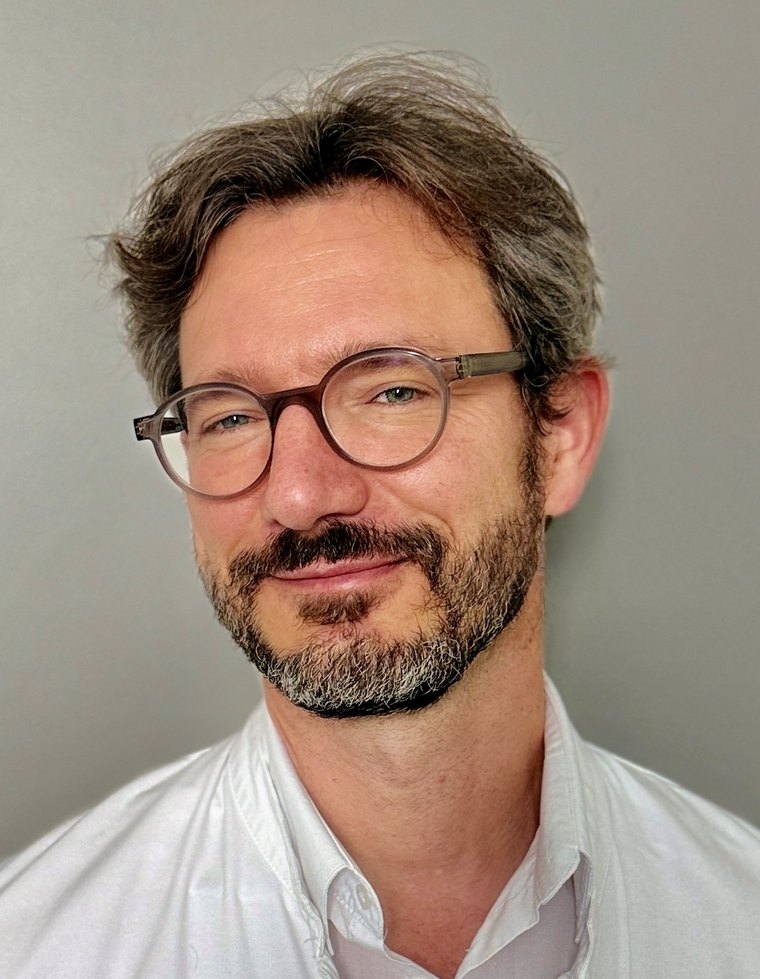
Clinical dermatologist, venereologist and scientist
Born in Basel, raised in Graubünden and Aargau. Medical studies in Basel and Paris, MD-PhD training as an experimental immunologist in Zurich, and a research fellowship in modern genomics at King’s College London.
Since November 2018, Chair of Dermatology and Allergology at University Hospital Basel and clinical professor of dermatology at the University of Basel. His approach combines clinical observation with measurable data — from genomics as much as from imaging.
Languages: German · English · French · Italian · Kiswahili.
Clinical scope
In 2025 the Department of Dermatology and Allergology at USB recorded around 82,700 outpatient contacts — from general dermatology to highly specialised care.
Core areas
- General dermatology
- Psoriasis and eczema
- Acne and hidradenitis suppurativa
- Dermato-oncology and skin-cancer screening
- Dermatologic surgery and emergency dermatology
Further fields
- Tropical dermatology
- Cutaneous infectiology
- Hair, STI and proctology
- Genodermatosis clinic
- Laser dermatology (FMCH I–V)
Navarini Lab — genotype meets phenotype
The Navarini Lab connects two worlds of data. Disease-driving genetic variants are uncovered and followed up functionally — with a focus on neutrophil-mediated and autoinflammatory skin diseases. The exome-wide sequencing that once carried this work is now complemented, and increasingly superseded, by spatial transcriptomics (NanoString), which locates disease-driving programmes at single-cell resolution directly within affected skin tissue. Work on generalised pustular psoriasis and the IL-36 axis (including IL36RN and AP1S3 variants) has shaped today’s disease classification and contributed to targeted therapies such as spesolimab.
In parallel, the team develops machine-learning methods for dermatology: self-supervised learning, data-quality and bias audits, anomaly detection and foundation models — alongside work on global fairness and diversity, for example using image data from Sub-Saharan Africa. Much of the code is released openly as Digital Dermatology (DBE University of Basel & HSLU).
At the Department of Biomedicine the group runs a keratinocyte organoid platform and an AI group for quantitative skin analysis. The aim is a robust genotype–phenotype correlation as a basis for future clinical decision support.
The full research group — AI, biomedicine and clinic — is presented at navarinilab.com. The lab is open to partnerships and accepts referrals for the genodermatosis clinic.
Sequence → Function → Therapy
Next-generation sequencing, functional validation and targeted therapies for autoinflammatory and immune-mediated skin diseases.
Image → Feature → Prediction
Dermoscopy and machine learning for objective, robust and fair image analysis — from data quality to foundation models.
Scientific contributions
Including contributions at computer-science venues (NeurIPS, MICCAI, CVPR and others). Full list on Google Scholar and PubMed.
Selected publications — clinic & genetics
Selected publications — AI & image analysis
Academic roles and committees
Leadership and offices beyond the immediate clinical and research work.
European Dermatology Forum
President of the European Dermatology Forum (EDF), the umbrella body of European dermatology. edf.one
ERASPEN · Pustular psoriasis
Principal Investigator of the international network for rare and severe psoriasis; director of the Swiss psoriasis registry (SDNTT).
International Psoriasis Council
Councilor and chair of the Digital Health and Telemedicine working groups.
Chief Physicians’ Spokesperson
Elected spokesperson of the chief physicians’ conference at University Hospital Basel.
Faculty Committee
Member of the Faculty Committee of the University of Basel.
Resources and platforms
Platforms, teaching and open code — and the University of Basel departments the group works across.
Navarini Lab ↗
The full research group — AI, biomedicine and clinic — with projects and team.
DermaCompass ↗
The digital dermatology textbook and clinical reference created by A. Navarini: 700+ diagnoses, 6,000+ images, EN / DE, with an AI assistant.
Dermatology Knowledge Trainer ↗
A daily specialist-knowledge trainer of dermatology cards for residents and students (access by code).
Digital Dermatology · GitHub ↗
The group’s open-source organisation — SelfClean, t-loss, PASSION and CleanPatrick among others.
Department of Biomedicine ↗
Skin Biology group — immunology, genetics and organoid models.
Department of Clinical Research ↗
Home of the clinical group, registries and trial infrastructure.
Department of Biomedical Engineering ↗
Imaging, modelling and the Digital Dermatology AI programme.
Dermatology & Allergology ↗
The university dermatology clinic and Skin Tumor Center.
Contact
Department of Dermatology and Allergology
Burgfelderstrasse 101
4055 Basel, Switzerland